
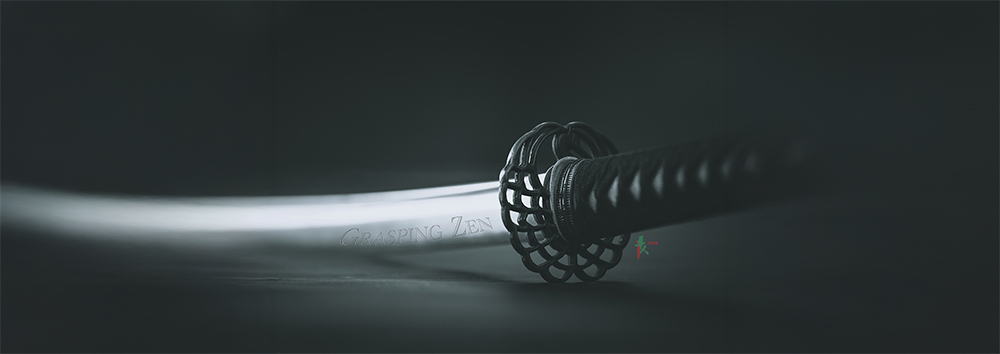
Iaido is the traditional art of the Japanese sword. More literally, "the way of drawing the sword." It is a fine art with deep Zen connections. Calm, meditative, and challenging in its detail and precision.
After decades of study in martial arts weapons, LCTKD became formally involved in Iaido in 2012, becoming one of the inaugural dojos when Mugai Ryu Meishi Ha was introduced into the UK in 2014, as well as offering students a wider perspective on Iaido from different traditional schools.
Seeking a more deeply philosophical, non-competitive, historically accurate and accessible approach to traditional sword arts, Neil R. Hall drew more and more on his half century of Zen study, his decades of teaching Tai Chi, and his study of martial arts history in his teaching of Iaido. In 2024, he brought these elements together in a coherent syllabus known as Ikikai Iaido.
I-ki-kai ("ee-key-kye") means the school where your ki (qi or chi in Chinese) flows in harmony with nature. It is a philosophical form of Iaido, based upon techniques and kata from ancient Ryu (schools), taught in a very traditional way, from a perspective that creates a flowing harmony. It emphasises technique over power, calmness over aggression. It is contemplative, flowing, and yet always precise, and is easy to adapt for students of different ages, with many students well beyond retirement age.
Ikikai Iaido is deliberately designed to be accessible, not only in its techniques, but also in its cost. It eschews the high fees, the huge cost in equipment, and progress only recognised through expensive compulsory workshops and increasingly expensive grading examinations, that is so often a facet of Iaido in the modern world. There were none of these things in the older Koryo schools going back to the 1500s, and there are none of these things in Ikikai Iaido. Its focus is on the practice, the philosophy, and the personal journey of its students.
The term Ikikai comes from the same root as the modern Japanese term Ikigai, "giving your life purpose." Ikigai has been taken up in the world of positive psychology, where the concept of Flow originated. The connection between the two is not intentional, but it's a nice coincidence.
Like most things Zen inspired, you need to do Iaido to appreciate just how far it takes you away from the quotidien life. It is learnt in the friendly, supportive and fun atmosphere of our Enso sessions. We invite you to come and experience it with us.
Is it Like Kendo?
Well, no. People often ask us this, so a brief explanation might help. Kendo is a popular Japanese sport in which armoured competitors fight with special weapons known as shinai, usually made from bamboo. Developed from sword arts after the Meiji Restoration of 1868, at a time when sword arts were not well thought of, Kendo is intense, competitive, needs a high degree of fitness, and is a great deal of fun.
Iaido, from the older Koryo schools going back to the 1500s, uses katana - that is, a version of a traditional Samurai sword. Some schools, like ours, include partner work with bokken - wooden swords - but this work is for understanding techniques and distances. It isn't fighting, it's not competitive, and there's no need for a high degree of fitness.
One wit put it this way:
"Kendo is dressing up in armour and hitting each other with big sticks, and Iaido is the tea ceremony with sharper instruments."
That's actually pretty accurate.
Interestingly, some Kendo schools do practice a modern interpretation of Iaido, formalised in 1968, alongside their main focus, which of course is the competitive sport of Kendo. Kendo's modern interpretation of Iaido is standardised for Kendo schools around the world and progression is by paid for grading examinations. The many Iaido schools in Japan and around the world with an older Koryo derivation, like ours, are respectful of, but quite distinct from that.
Isn't it illegal to possess a Samurai Sword?
As a matter of fact, in England and Wales, where we are based, it is normally illegal to possess the types of swords we use in our training, the general term for which is katana, though in popular parlance they are called Samurai swords. So how come we can use them? You are allowed to have them if you are training in a martial art that genuinely requires them. If you aren't, it is likely that simply having a Samurai sword in your home is illegal, even if you are just borrowing it, or looking after it for someone. The laws about selling Samurai swords are also very strict, so if you are fascinated by Iaido and keen to try it, please don't try to borrow or buy a sword, just come along without one. When it comes time to buy a sword, we can guide you on how to do that safely and legally.
You can read our plain English guide to swords and the law for our students by clicking on the link below. There are also links further down the page to our Iaido classes.
